Showing posts with label Hawaii. Show all posts

Sunday, February 9, 2014

Gold Accents in Metal Clay


I love silver.  I always have.  Maybe it's because I have childhood memories of traveling to the southwest and seeing beautiful silver and turquoise work.  Maybe it's because there so many cultures from so many different parts of the world that have stories of silver that are incorporated into their mythologies.  I just know it is one of the materials I have always been drawn to.  That does not by any means make it the only material I work with.  Every once in a while, a piece calls for something more.  The piece featured in this post was inspired by "Pele's Hair", volcanic glass threads that are created when molten material is thrown into the air.  They look like piles of golden volcanic hair and called for some color accents to this piece.  
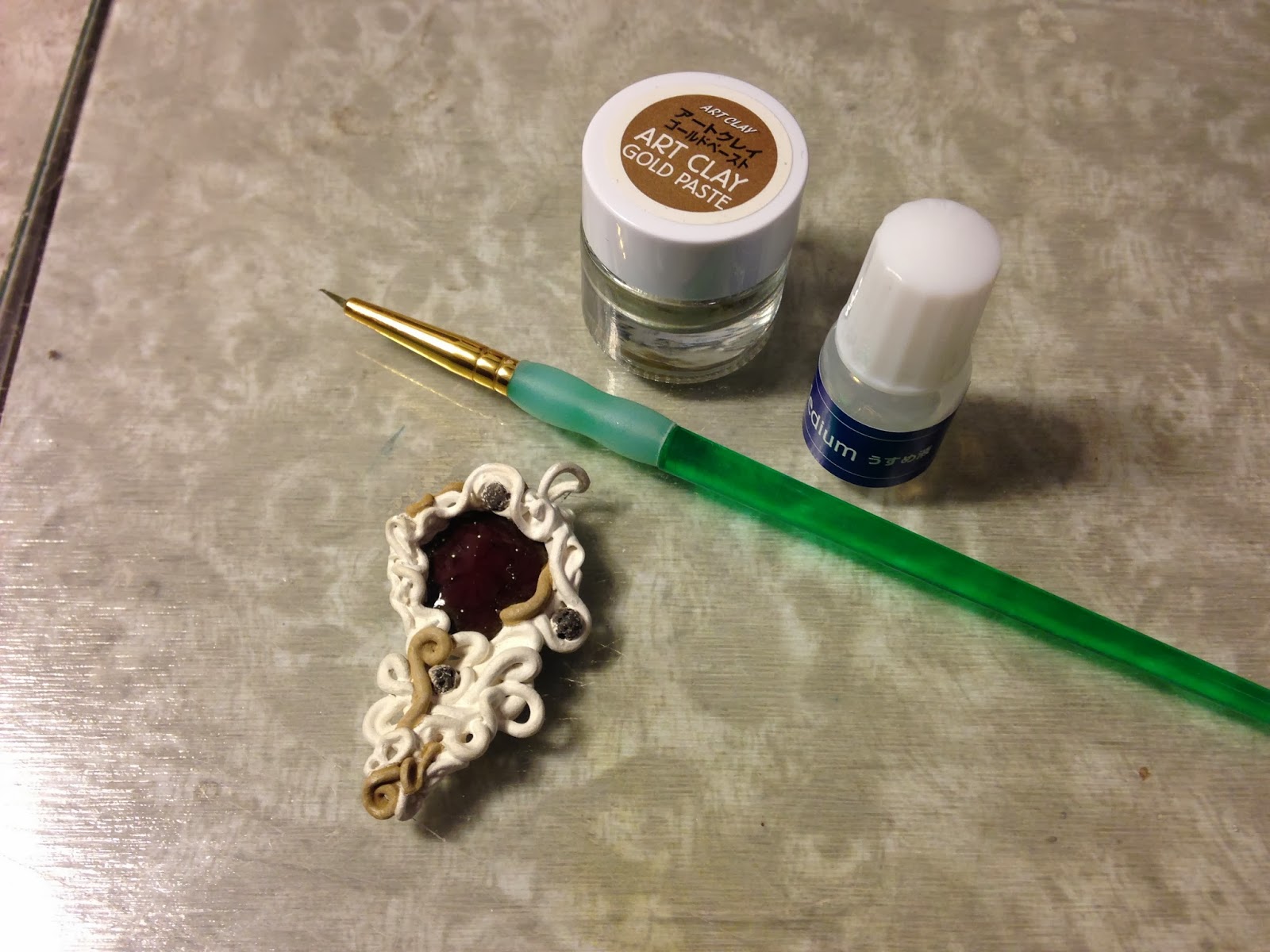


Before incorporating the gold, the base form was built using silver clay coils wrapped around black glass and volcanic beads.  The piece was fired in the kiln to burn out the clay binders and just leave the glass, beads and silver.  When silver comes out of the kiln, it has a matte white finish that is normally brushed to reveal the shining metallic surface, not in this case.  I applied overlay paste to the areas I wanted to accent.  Once dry, I slowly built up layers of the gold paste until it reached a mustard color.  At this point it can either be kiln fired or torch fired to burn out the binder and leave the gold.  The key is speed!  On the above right, there is an image of the piece glowing from the torch fire, once that glow appears (this is best done in the dark) you are only holding it for a few seconds.  Any longer and the gold and silver will melt together and you will lose your accent.  The more layers of paste, the deeper the color in the end.  Just like silver, after firing it will still be that matte mustard color and must be brushed to reveal its luster.

I used Art Clay Gold Paste over the fine silver to create these accents.  After firing the gold left is 22k and can be used on glass and porcelain, as well.  While this is a relatively affordable way to work with gold, at the end of the day it is real gold and you are still paying market price for it.  I initially worked with both gold paste and gold sheet in my senior certification class with Art Clay World.  The instructions that come with both are good and there are lots of great video tutorials online, but for the price of gold it is really something best introduced in a class with an experienced teacher.  It will save you frustrations and some very expensive experimenting!


Sunday, September 1, 2013

Artistic Voice


Kilauea, 2013
Ring:  Fine Silver, Lava Rock, Black Sand & Glaze

"I paint objects as I think them, not as I see them."  -Picasso

As the semester begins, I will spend a lot of time helping my students to push beyond the literal.  As they are asked to find inspiration for their artwork, they will also be asked to begin interpreting their own world.  I want them to understand how their experiences and perspectives shape their artistic voice.  I hope to empower them to develop original work that is all their own.  This is often hindered by the fact that they are submerged in a popular culture that is overloaded with simplistic graphic symbols for the purpose of appealing to mass audiences.  I read a very critical article this week on a professional jewelry blog about the ethics of jewelry artists stealing each others' designs.  When I scrolled down to see the images, all I could do was chuckle.  Two competing popular jewelry designers have come out with similar lines, but how either one can claim originality is laughable.  Each piece was based on common symbols such as lightning bolts, hash tags and @ symbols.  They were simple pendants in gold that all appeared to be maybe 2" in length, with one designer incorporating diamonds.  I think the only person who had a right to feel robbed was Max Miedinger who originally designed the Helvetica font these appear to be based on.  There was no transformation, so there was no artistic voice to protect and no lasting relevance to connect to.  
Kilauea Side View
(Photo Credits this page: Amber Jones, Studio Pura, LLC)

"Inspiration exists, but it has to find us working." -Picasso

The images in this post are from one of my most recent pieces.  Bringing this work into class served as a catalyst for our discussion on creating relevant work by interpreting our own experiences.  I am very much influenced by my environment.  Not necessarily "the environment", but my environment - wherever I am physically spending time.  I work to capture the essence of each place that influences and subsequently inspires me by eternalizing the brief moments I spend there.  This ring gives permanent form to the fleeting minutes I found myself overlooking a smoking crater in Volcanoes National Park.  It goes beyond documenting the park and becomes about documenting my experience - being mesmerized by the billowing smoke which I have interpreted through the undulating silver, being drawn into the glow in the evening from the lava interpreted through the glaze disc and having these ephemeral sensations disrupted by the rough lava rock surrounding me.  This piece began the moment I stood before this crater.  It continued as I walked the trail of devastation and eventually followed the lava flow down to where it emptied into the sea.  It began as photographs and sketches and quiet nagging thoughts of how to process a new and fundamental understanding of the actual creation of the earth.  What I find most interesting is now writing this post, I am able to make connections to pieces I was doing a decade ago.  I hadn't visited this place and I worked on a much larger scale and in completely different materials, but there are still clear visual and conceptual relationships between my work from then and now.  I remind my students that as each of our artistic voices gets stronger, we can spend less and less time laboring over what makes our work our own because the more we use it the more the visual language we develop comes naturally to us.  This means the less and less time we need to spend worrying if it will be mistaken for someone else's.